Understanding Pet Aftercare
After saying goodbye to a pet, families are faced with a practical decision during an emotional time: what should happen afterward?
For many Long Island families, the main choice is between private cremation and communal cremation. The difference is important because it determines whether your pet’s cremated remains are returned to you.
Neither option reflects how much you loved your pet. The right choice is the one that fits your family’s wishes, beliefs, budget, and feelings about keeping ashes or creating a memorial.
What Pet Cremation Means
Cremation uses heat to reduce a pet’s body to bone fragments. Those fragments are then processed into what families commonly call ashes or cremated remains.
The International Association of Pet Cemeteries and Crematories, or IAOPCC, publishes terminology and standards used within the pet aftercare profession.
Understanding those terms matters because different cremation methods can sound similar when families are comparing providers.
Ashes Returned
Private Cremation
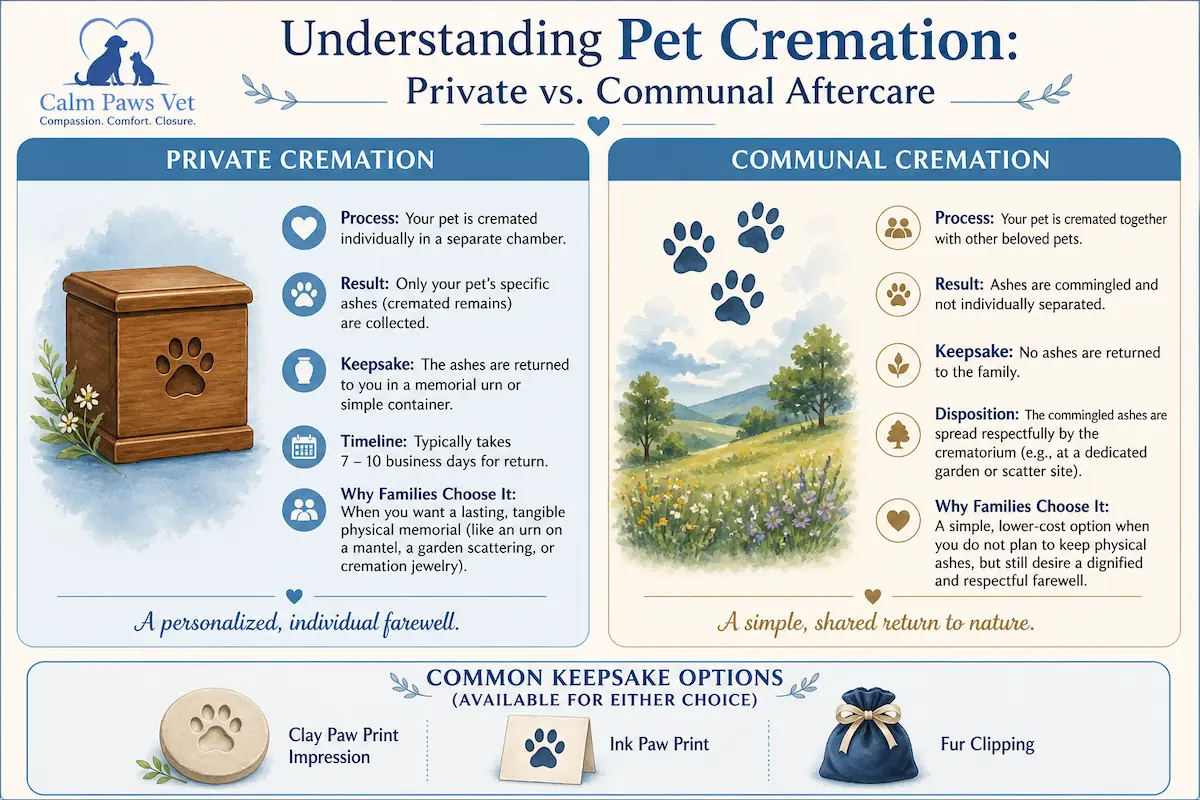
IAOPCC defines private cremation as a process in which only one pet is placed in the cremation chamber and that pet’s cremated remains are returned to the client.
- One pet is cremated in the chamber.
- Cremated remains are returned to the family.
- The family can decide later how to keep or memorialize the ashes.
No Ashes Returned
Communal Cremation
IAOPCC defines communal cremation as cremating multiple pets together without keeping the individual pets separated. Individual cremated remains are therefore not returned to families.
- Multiple pets are cremated together.
- Individual remains are not separated.
- No individual ashes are returned to the family.
You may also see terms such as individual, segregated, or partitioned cremation.
IAOPCC recognizes a separate category in which more than one pet may be in the cremation chamber while some form of separation is maintained and each pet’s location is documented. Ask the provider exactly what their terminology means rather than assuming every company uses the same words.
Private vs. Communal Cremation at a Glance
| Question | Private Cremation | Communal Cremation |
|---|---|---|
| Are ashes returned? | Yes | No individual ashes are returned |
| Is the pet cremated alone? | Yes, under the IAOPCC definition of private cremation | No |
| Can I keep or scatter the ashes later? | Yes, subject to applicable rules for where the ashes are placed or scattered | No individual ashes are available |
| Is it usually more expensive? | Private cremation generally costs more | Communal cremation is generally the simpler lower cost option |
Questions That Can Help You Choose
- Is it important to me to have my pet’s ashes returned?
- Would I like to keep an urn in my home?
- Do I imagine scattering or burying the ashes somewhere meaningful where permitted?
- Would another type of memorial feel more meaningful than keeping ashes?
- Are there other family members who should be included in the decision?
- Do I understand exactly what is included with the option I am choosing?
You do not need to know immediately what you will eventually do with cremated remains. If having your pet’s ashes returned feels important, private cremation preserves that choice. You can decide on the final memorial later.
Questions to Ask a Pet Cremation Provider
A good aftercare provider should be able to explain its process clearly. You should feel comfortable asking what happens from the moment your pet enters their care until the aftercare process is complete.
- What does your facility mean by private cremation?
- How is my pet identified and tracked?
- Will my pet be the only pet in the chamber with the option I selected?
- How are cremated remains identified before they are returned?
- What is included with the cremation option?
- Are paw prints or other keepsakes available?
- How will I receive my pet’s ashes?
- What is the current expected return time?
- Are there additional fees based on pet size or memorial selections?
IAOPCC accreditation standards address areas such as transportation, identification, record keeping, cremation procedures, facility practices, and staff training. Families can also ask whether the crematory is an accredited or current IAOPCC member.
Current Calm Paws Vet Aftercare Options
Calm Paws Vet currently offers coordinated private and communal cremation options for families who would like Dr. Jake to handle aftercare.
The current Calm Paws Vet Aftercare page lists what is included, how pricing is determined, how ashes are returned, and the current expected timeline.
I recommend using that page for current service details rather than relying on an older blog article because crematory packages, included keepsakes, pricing, and turnaround times can change.
Memorial Options Beyond the Cremation Choice
Cremation is only one part of aftercare. The way you remember your pet can be completely personal and does not have to be elaborate.
Paw Prints
A clay or ink impression can preserve a small physical reminder of your pet.
Photos and Memory Boxes
Photos, collars, tags, favorite toys, and written memories can become part of a simple family memorial.
Living Memorials
Some families choose a plant, tree, garden feature, donation, or another remembrance connected to their pet.
If children are grieving too, consider giving them an age appropriate choice about how they would like to remember the pet. Our guide on talking to children about a pet’s death may help.
What About Home Burial?
Some families consider burial on private property instead of cremation. Because requirements can depend on state rules, local ordinances, property conditions, and how the pet died, do not rely on a general internet article to decide whether a particular burial location is permitted.
Check the current requirements that apply to your property and municipality before making arrangements.
Burial after euthanasia also requires an important safety consideration.
Drugs used for euthanasia can remain in an animal’s tissues after death. Pentobarbital exposure has caused poisoning in wildlife and other animals that consumed euthanized carcasses.
If you are considering home burial after euthanasia, discuss safe handling and disposal with the veterinarian and make sure the body cannot be accessed by scavenging animals.
When Possible, Make the Main Decision Before the Appointment
You do not need to plan every memorial detail before your pet dies. The most useful decision to make in advance is what should happen with your pet’s body afterward.
Knowing whether you want private cremation, communal cremation, or another appropriate aftercare arrangement means you do not have to compare basic options immediately after saying goodbye.
If you are still preparing for an in home visit, our What to Expect page explains how the appointment works from arrival through aftercare.
How Aftercare Fits Into an In Home Goodbye
Families who choose Calm Paws Vet can discuss aftercare before the appointment. If you choose an aftercare option coordinated through Calm Paws Vet, Dr. Jake handles the next steps so you do not have to manage transportation immediately after the goodbye.
Current details about the available options should always be confirmed through the Aftercare page or directly with Dr. Jake.
Frequently Asked Questions About Pet Cremation
Does private cremation mean my pet is cremated alone?
Under the IAOPCC definition, yes. Private cremation means only one pet is placed in the cremation chamber and that pet’s cremated remains are returned to the client. Because terminology can vary between businesses, confirm what the provider means when using the word private.
Will I receive ashes after communal cremation?
No. In communal cremation, the remains of multiple pets are not kept individually separated, so individual ashes cannot be returned to the family.
How much does pet cremation cost on Long Island?
Pricing can vary based on the cremation option, the pet’s size, the provider, and any additional memorial selections. For Calm Paws Vet’s current options and pricing information, contact Dr. Jake or review the current Aftercare page.
How long does it take to receive ashes?
Turnaround time depends on the crematory and current workload. Calm Paws Vet publishes its current expected return timing on the Aftercare page. Confirm the current estimate when arranging aftercare rather than relying on an older blog post.
Do I have to choose an urn before the appointment?
Not necessarily. The important decision is the type of aftercare you want. If you choose an option where ashes are returned, many memorial decisions can be made later. Confirm what container or urn is currently included with the specific provider.
Can I scatter my pet’s ashes anywhere I want?
Not automatically. Rules can depend on whether the land is private, public, or subject to another property’s policies. Confirm permission and any applicable rules before scattering cremated remains.
Is communal cremation less respectful than private cremation?
No. The main difference is whether the pet is cremated alone and whether individual ashes are returned. A family choosing communal cremation is not choosing a less loving goodbye.
Helpful Next Steps
Current Aftercare Options
Review the current private and communal cremation options coordinated through Calm Paws Vet.
What to Expect
Understand what happens during an in home euthanasia appointment and how aftercare fits into the visit.
Pet Aftercare and Grief
Learn more about memorial choices, family planning, and support after the loss of a pet.
I care for families across Suffolk County and Long Island’s North Shore. In the Three Village and Setauket area, in home visits are scheduled for weekday evenings and weekends, with daytime weekday visits available for families further out on Long Island.
Have Questions About Aftercare?
If you are planning an in home goodbye and want to understand the current private cremation, communal cremation, or other aftercare choices available through Calm Paws Vet, you can talk with Dr. Jake before the appointment.